
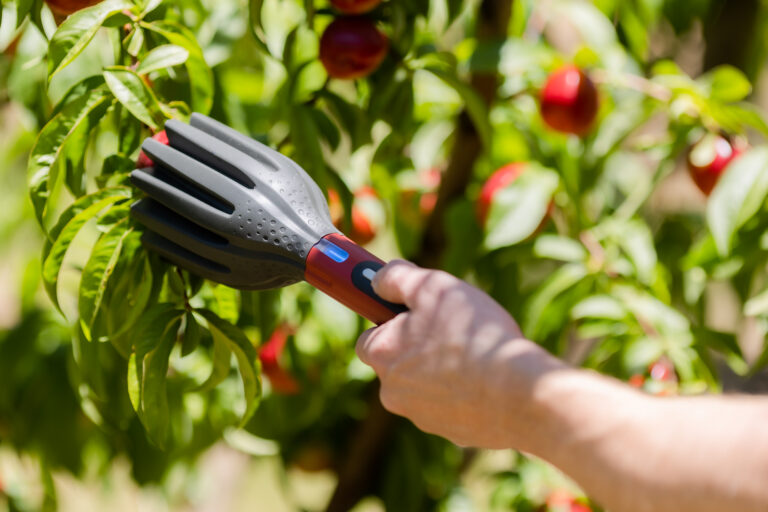
In this edition of our „Innovation Perspectives“ business series, we speak with Daniel Pelliccia, the founder of Rubens Technologies. As a partner in our Food Systems network, Daniel shares the journey of developing a groundbreaking device for non-destructive fruit quality assessment, its global relevance, and his vision for the future of the fresh produce supply chain.
Nikita Sklyomin (T+I Consult): Daniel, thank you for joining us today. To start, could you tell us about your background and the founding history of Rubens Technologies?
Daniel Pelliccia (Rubens Technologies): Thank you for having me. I am the founder of Rubens Technologies. By background, I’m a physicist with about 10 years of research experience in Italy, Germany and Australia. My work was primarily in optical physics and spectroscopy.
The company was officially incorporated in late 2018, taking shape from a project I was involved in as a consultant for a government research institution here in Australia called Agriculture Victoria. They were looking at new sensors to assess fruit quality, and I started designing a prototype. The idea showed great promise, and I began developing it further. The first full prototypes were tested around 2020, and our first paying customers came in 2022. The device you see today is the result of several generations of refinement.
Nikita: What was the core problem you set out to solve with this product?
Daniel: The primary problem is that most fruit quality assessment is destructive. It involves cutting fruit, squeezing juice to measure sugar content, or other manual methods to gauge maturity and quality. This process is slow, messy, wastes product, and the data isn’t efficiently captured in a digital format.
Our goal was to create a solution for non-destructive quality assessment. This is crucial at two key stages:
- Pre-harvest: To help growers determine the optimal time to pick their fruit, balancing market requirements, weather, and labour constraints.
- Post-harvest: For quality assurance (QA) in packing, retail, and shipping. This helps ensure the fruit meets the required quality attributes like sugar content and firmness for the buyer.
Nikita: What is the unique selling proposition (USP) of your technology, and how does it differ from other similar products on the market?
Daniel: At its core, the Rubens device uses spectroscopy. It shines a light on the fruit and measures the reflected wavelengths to determine its maturity stage.
While other spectrometer-based systems exist, our key differentiator is the device’s multi-crop capability. We designed our system with cloud-based calibration models. The device itself is hardware that collects the data; the analysis is done in the cloud. This means a single Rubens device can measure different crops – from an apple to a pear – by simply changing a setting in the smartphone app. You don’t need a new device for each crop.
This design philosophy has also allowed us to make the device itself very simple: lightweight, with long battery life, making it perfectly suited for a full day’s work in the field. The data is automatically collected and stored, eliminating manual transcription errors.
Nikita: The product was developed in-house, but did you collaborate with any research partners?
Daniel: While the engineering and design were all in-house, we had a very important partnership with Agriculture Victoria. Their research station gave us invaluable access to orchards where we could test the device on fruit as it was maturing on the tree, which is vastly different from testing on market-ready fruit. They served as an excellent test bed during our development phase.
Nikita: This is clearly a global problem. How relevant is your solution in Europe and specifically in Germany?
Daniel: Absolutely. The need for efficient fruit quality assessment is global, affecting crops like apples all the way up to Northern Europe. The post-harvest QA applications for packing houses and retailers are also universally relevant.
We are already seeing strong interest in Europe. Our distribution network includes customers in Germany, and we have active trials and customers in Italy, France, Spain, and the UK. In Germany, the KOB competence centre is using our devices for various projects, and we are looking to expand this collaboration.
Nikita: What are the benefits of participating in international networks like our Food Systems network?
Daniel: The network has been fantastic for reinforcing and expanding collaborations. For example, our work with the KOB centre in Germany has grown from an initial trial on apples to include plums.
Beyond that, it opens doors to new applications. Through the network, we’ve had discussions with the University of Queensland about using our technology to measure chlorophyll in algae. The system’s ability to measure chlorophyll is a key indicator of fruit maturity, but it has many other potential applications, including marine environments. The network provides a great opportunity to explore these new fields and connect with potential partners.
Nikita: Looking to the future, what are the main challenges for Rubens Technologies in terms of development, introduction, and financing?
Daniel: Like many tech companies, funding is always a challenge, especially for hardware. We have chosen to grow organically, which slowed our time to market but allowed us to retain full control.
One of the biggest technical and commercial challenges is the calibration process. Our spectrometer data doesn’t tell you about the internal quality of a fruit until we build a machine learning model. Developing these models requires a significant upfront investment—scanning thousands of fruits with Rubens and doing conventional destructive tests to create a training database. However, once this is done, the advantages for the customer are immense.
Nikita: What are those key advantages you’ve seen in practice?
Daniel: There are three main benefits we consistently hear from our customers:
- Saving Fruit: One of our packhouse customers scanned 25,000 apples (about 4 tonnes) in one year without cutting any of them.
- Saving Time: The scan is two to three times faster than the destructive process, and there’s no messy cleanup.
- Digital Data: The data flows seamlessly via our API into their management systems. They generate reports automatically for their supermarket buyers, significantly reducing paperwork.
Now that our database is growing—with nearly 200,000 apple scans from around the world—the calibration process is becoming faster and easier for our clients.
Nikita: What future trends and technology fields are you looking to tap into?
Daniel: A major driver for us is waste reduction. Globally, about 30% of produce is wasted, which represents a huge economic loss and a significant carbon footprint. A fruit that is rejected at a supermarket has already incurred the cost and carbon emissions of being grown, stored, and transported across hundreds or thousands of miles. Our goal is to provide transparency across the supply chain so that problems are detected early, reducing waste at every stage and improving overall sustainability.
Nikita: And finally, what kind of cooperation partners are you seeking for future projects and market development?
Daniel: Our model is to focus on developing the technology and calibration models rather than managing direct sales. We are always on the lookout for two types of partners:
- Distribution Partners: Especially for crops other than apples or for new use cases.
- Agronomy Services: These are agronomists who already advise fruit growers on soil, fertilisers, tree health, harvest timing, etc. Rubens could be a valuable tool in their service offering.
We are very interested in strengthening connections in the German and broader European market. Through networks like this one, we hope to find partners who share our vision for a more efficient and sustainable food system.
About Rubens Technologies
Rubens Technologies has developed a pioneering, non-destructive fruit quality assessment device. Powered by spectroscopy and cloud-based analytics, its multi-crop capability offers a faster, data-driven, and more sustainable approach to managing the fresh produce supply chain.
About T+I Consult
T+I Consult is an international innovation consultancy. With our „Food Systems“ network, we connect companies from science and research to foster innovation, support market development, and promote sustainability in the food industry.


