Nikita Sklyomin (T+I Consult): Andrew, thank you for joining us. Could you start by telling us about your professional background and the founding of Cellysis?
Andrew Inglis (Cellysis): Thank you for having me. I’m an industrial food scientist with experience across the entire production spectrum – from the factory floor to production management, R&D, and quality assurance. My later career has focused on process development, essentially acting as the bridge between food science and engineering.
The company itself is relatively recent, but the technology’s roots go back much further. My informal co-founder, who has a background in software, vision systems, and robotics, handles the engineering and control systems. Together, we’ve turned a concept that was first explored in the 1990s into a commercially viable solution.
Nikita: What was the core problem you set out to solve?
Andrew: The initial motivation was food safety, specifically the challenge of eliminating pathogens from processed meats. We began with bench-scale research, and by 2001, we had CSIRO validation studies showing significant (99.9999%) log reductions of Listeria monocytogenes. However, at that time, there was no practical way to engineer a system for a commercial environment.
I picked the project back up in 2019 with a new engineering concept and expanded the chemistry. We developed a way to safely mix and apply a combination of food-grade gases – including acetic acid (vinegar), hydrogen peroxide, and peracetic acid – in a unique heat vaporization process. After building a pilot plant, we now have three years of successful, safe operation.
Nikita: What makes your technology unique compared to other solutions on the market?
Andrew: There are a couple of technologies in this space, but we stand apart in several key ways. First and foremost is efficacy. We are consistently achieving 6-log reductions (99.9999%) and greater of pathogens like Listeria, even on sensitive products like cut fruit. This places us in the same performance category as thermal canning or high-pressure processing, not standard water washes.
Our control and verifiability are also unique. We data-log around 23 process points (scalable to 30) and can provide verification data every millisecond. This allows us to offer a fully validatable and verifiable process, which is critical for food safety compliance.
Finally, our technology is incredibly efficient. We use up to 80% less chemical than conventional wash systems, and our process is highly adaptable. We can adjust the chemistry and dosage to suit different food matrices, avoiding any damage to the product itself.
Nikita: The product was developed in-house, but did you collaborate with any research partners?
Andrew: The core development has been entirely in-house. However, we did have an important early collaboration with CSIRO for initial validation work. More recently, our validation has been completely industry-verified, with full chain-of-custody testing conducted by independent labs.
Nikita: Is this a global problem, and is your solution relevant outside Australia?
Andrew: Absolutely. Foodborne illness and food waste are global challenges. The beauty of our gas-phase technology is that it can be integrated relatively easily into existing production lines, just prior to packing. It’s effective on a huge range of products – from fresh produce and cut fruit to poultry, red meat, seafood, and even baked goods. Whilst there are no regulatrory hurdles in countries like USA and Australia. we are currently not focusing on European markets due to regulatory hurdles, but the need is universal.
Nikita: What are the advantages of participating in international networks like our Food Systems network?
Andrew: Networking, which ultimately leads to commercialization, is far more difficult than the science and engineering. I’ve been fortunate to have built some valuable connections through other initiatives, such as with Hort Innovation in Australia, which have helped open doors to regulators and industry. However, the Food Systems network is still relatively new for me, and I see great potential in it. The ability to connect with like-minded innovators and potential partners across different regions is exactly what we need as we prepare for the next stage of commercialization. These networks are essential – without them, getting a technology like this to market would take significantly longer, if it happened at all.
Nikita: What are the main challenges for Cellysis in terms of development, introduction, and financing?
Andrew: For a true food safety process, our technology is remarkably affordable – about 10% of the capital and operational costs of alternatives like HPP or UHT. Our main financing challenge right now is covering the one-off costs for our first commercial plant, primarily for software development and final automation.
Nikita: What future trends or technologies are you looking to tap into?
Andrew: We are developing a new range of highly accurate gas sensors. This will give us even greater precision at the end of the process, adding an extra layer of verification. It’s slow-going due to funding, but we have a prototype and a clear path forward.
Nikita: And finally, what cooperation partners are you seeking for future projects and market development?
Andrew: We are at TRL 6 (Technology Readiness Level 6) and our immediate goal is to get our first commercial plant operational, which we hope will happen in early 2027. Once we have that operational data, we’ll be looking for industry partners in other countries. We prefer a model where plants are built locally, so we are seeking partners for scaling, sales, and support in key regions.
Nikita: That’s a very sustainable approach. Before we conclude, is there anything else you’d like to share?
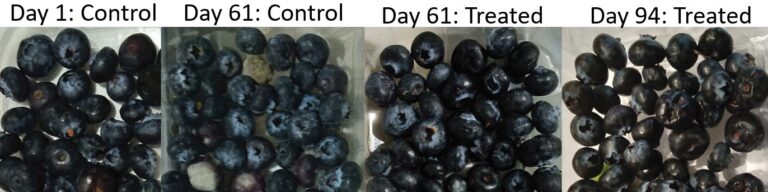
Andrew: Yes – the shelf-life extensions we’re seeing are just as transformative as the food safety improvements. For example, we’ve extended blueberry shelf life from 14 days to over 32 days in standard packaging. When packed wet we’ve kept blueberries in sealed, airtight bags at 4°C for 94 days with no mold growth.
This capability opens up entirely new export markets. A grower who could previously only ship within their region can now reach customers across the globe, all while significantly reducing food waste.
Another achievement I am personally proud of is our vaporisation process actually increases the purity of these three food grade gases.
Nikita: Thank you, Andrew. The work you are doing is truly incredible and could change the food industry for the better.
About Cellysis
Cellysis, trading as GasSan has developed a revolutionary, gas-phase food safety and preservation technology. Using a unique combination of food-grade gases, their system delivers validated 6-log pathogen reductions, extends product shelf life dramatically, and reduces chemical usage by up to 80% compared to conventional methods.
About T+I Consult
T+I Consult is an international innovation consultancy. With our „Food Systems“ network, we connect companies from science and research to foster innovation, support market development, and promote sustainability in the food industry.